
Stop Treating the Symptoms: Start Solving the Real Cause of Farming Problems


Every farmer knows the pressure.
Insects arrive. Weeds take over. Animals don’t perform. Soil gets compacted. Fertiliser bills climb. Profit margins shrink.
And almost every time, there is a commercial product waiting with a promise:
“Use this and the problem will go away.”
For insect attack, there are insecticides.
For weeds, there are weedicides.
For fungal disease, there are fungicides.
For worms, there are drenches.
For poor soil nutrition, there are synthetic fertilisers.
For animal problems, there are medications, antibiotics and vaccines.
For compaction, there is deep ripping.
For lack of profit, the common advice is often: get bigger, increase production.
But here is the question Hugo was asking all those years ago — and it is still just as important today:
Are we solving the real problem, or are we just paying more every year to manage the symptoms?
At Farming Secrets, we believe farmers deserve independent, practical information that helps them get to the cause of their problems, not just buy another product for the symptom. That has always been central to the Farming Secrets mission: helping farmers reduce chemical dependency, rebuild soil health, lower costs and farm with more confidence.
The Costly Cycle Many Farmers Are Trapped In
The modern farming system often teaches farmers to respond to problems with inputs.
See a weed? Spray it.
See a pest? Kill it.
See poor growth? Add fertiliser.
See under-performing animals? Medicate them.
See compacted soil? Deep rip.
Sometimes an intervention may be necessary. But if the same problem keeps coming back year after year, it is worth asking:
What is the farm trying to tell me?
A weed problem may be telling you something about soil imbalance, bare ground, compaction or lack of plant diversity.
An insect problem may be pointing to weak plants, poor mineral balance or a lack of beneficial predators.
Animal ill thrift may be connected to pasture quality, mineral availability, soil biology or stress.
Compaction may not just be a mechanical problem. It may be a biological problem, caused by low soil life, poor aggregation, low organic matter and lack of deep living roots.
When farmers only treat the visible symptom, they often stay dependent on the next input. And that dependency can become expensive, stressful and disheartening.
This speaks directly to what many farmers feel today: rising input costs, chemical dependency, shrinking margins and the fear that the farm may not remain viable for the next generation.
The Real Question: What Is Happening in the Soil?
Hugo’s hot tip was simple but powerful:
Prioritise the soil when considering any action on your farm.
That means every decision starts with one question:
Will this help or harm the life in my soil?
Your soil is not just dirt. It is a living system. Healthy soil contains bacteria, fungi, protozoa, earthworms, insects, living roots and organic matter all working together. This living system helps cycle nutrients, build structure, hold water, support plant immunity and reduce the need for costly external inputs.
When the soil is alive and covered, the whole farm starts to function differently.
Plants become stronger.
Carbon is stored.
Water infiltration improves.
Nutrient cycling increases.
Pastures recover faster.
Animals often perform better.
Input costs can begin to fall.
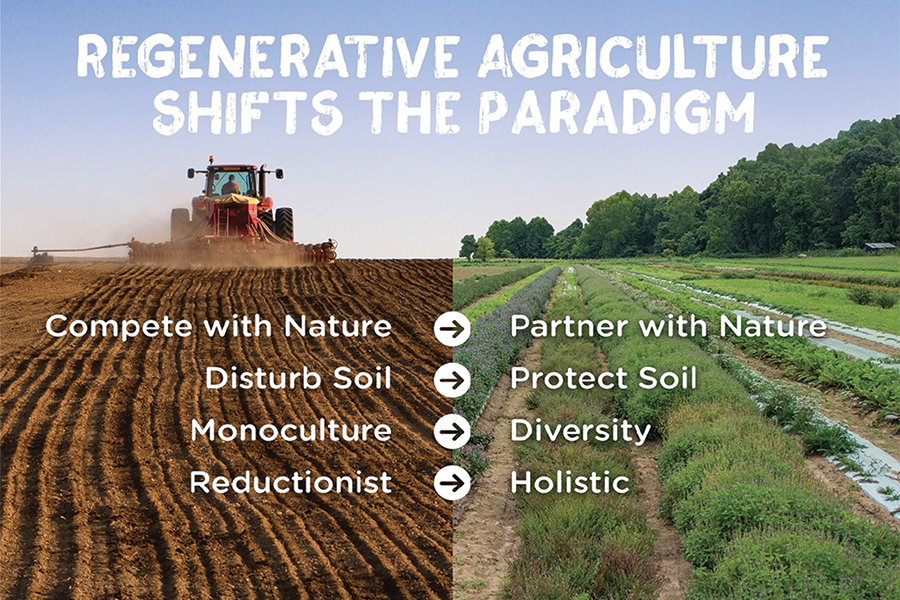
This is why regenerative farmers focus so strongly on soil cover, living roots, plant diversity, reduced disturbance and livestock integration where appropriate.
Soil Cover: The Second Part of Hugo’s Tip
Hugo’s second recommendation was:
Aim for maximum soil cover.
Bare soil is vulnerable soil.
When soil is left exposed, it can overheat, crust, erode, dry out and lose biology. Bare soil also creates opportunity for weeds because nature always tries to cover the ground.
So instead of asking, “How do I kill the weeds?” a regenerative farmer may ask:
Why is nature trying to cover this soil, and what can I grow here that will do a better job?
Soil cover can come from:
- Productive pasture
- Mulch
- Crop residues
- Cover crops
- Diverse plant species
- Managed grazing recovery
- Living roots in the ground for longer periods
The goal is not just to have something green. The goal is to feed the soil, protect the surface and create conditions where desirable plants can outcompete weeds naturally.
Before You Use Any Input, Ask This
Before applying any product — whether it is a herbicide, pesticide, fungicide, fertiliser or animal drench — pause and ask:
Will this build life or reduce life?
That one question can change the way you farm.
If a product is designed to kill a weed, pest, fungus or parasite, it may also affect other parts of the living system. That does not mean a farmer should never use an input. It means the input should not be the whole strategy.
A better approach is to ask:
“What is the cause of this problem?”
“What conditions allowed it to happen?”
“How do I change those conditions?”
“What can I do that supports soil life rather than damaging it?”
“Is there a biological, grazing, mineral, compost, diversity or management-based alternative?”
This is where farmers begin to move from reaction to observation. From dependency to independence. From symptom management to system repair.
The Profit Is Often in What You No Longer Need
One of the most overlooked paths to profit is not always producing more.
Sometimes it is needing less.
Less synthetic fertiliser.
Less chemical intervention.
Less animal medication.
Less re-sowing.
Less fuel.
Less machinery repair.
Less stress.
Many farmers have been told the only way to survive is to get bigger and produce more. But bigger is not always better if the costs get bigger too.
A healthier farm system can improve profit by reducing waste, lowering inputs and making the land more resilient. This is the heart of Farming Secrets: practical, real-world education that helps farmers work smarter, not harder.
The Farming Secrets Approach
Farming Secrets was created to gather and share the knowledge of farmers and experts who looked deeper.
Instead of only asking, “What product fixes this?” they asked:
“What caused this?”
“Who has solved it?”
“What can other farmers learn from them?”
“How can we make this practical and achievable?”
That is why Farming Secrets has always focused on successful farmer stories, interviews, with the expert, videos, courses and community education. Farmers need more than theory. They need to see what is working on real farms, in real conditions, from people who have faced and dealt with the same problems.
And just as importantly, farmers need encouragement. Transitioning away from chemical dependency can feel risky and isolating. Many farmers are afraid of making the wrong choice, losing yield, being judged by neighbours, or wasting money on something that does not work.
That is why the first step does not need to be a complete overhaul.
It can be a question.
Will this decision improve the life in my soil?
Practical Steps You Can Take
Start small, but start observing.
Walk your paddocks and look for bare soil, compaction, weak plants, weed patterns and water movement.
Dig a small hole and look for roots, aggregation, earthworms, smell and moisture.
Notice where animals perform best and ask what is different about those areas.
Before buying the next input, ask whether it solves the cause or only suppresses the symptom.
Look for ways to keep soil covered for living plants for longer.
Consider trialling one regenerative practice on one paddock before making whole-farm changes.
Learn from farmers who are already reducing inputs successfully.
This is not about doing everything overnight. It is about changing the direction of your decisions.
Hugo’s Hot Tip, Rewritten for Today
Prioritise the soil in every decision you make.
Aim for maximum soil cover.
Before using any input, ask whether it will help or harm the living systemin the soil beneath your feet.
If the product is designed to kill something, take time to understand what else it may negatively affect and whether there is a better way to address the cause.
Because when you discover the importance of soil life and the role it plays you begin to build a farm that is healthier, more resilient, more profitable and more enjoyable to run.
That is the real secret.
Not another product.
Not another quick fix.
But understanding the cause — and working with nature to remove the need for the remedy.




Responses